


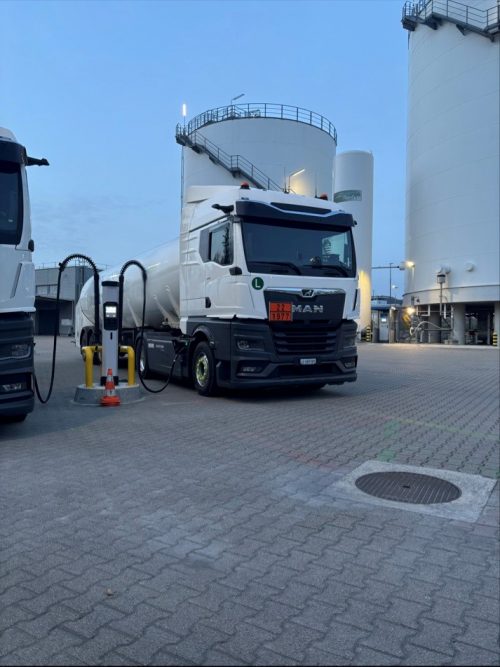
Electrified trucks strengthen sustainable transport solutions in regular operations.
The HOYER Group is further expanding its commitment to alternative drive technologies and has put four fully electric trucks into operation in Switzerland. With this step, the globally active logistics provider specializing in the handling and transport of liquid goods is taking another step toward sustainable, customer-focused logistics solutions. The e-trucks are deployed for daily route planning in regular operations. An
intelligent charging system manages the energy supply based on the deployment schedule for the following day. The drive technology and charging efficiency support the decarbonization ambitions of the HOYER Group while ensuring reliable transport operations.
The implementation of fully electric vehicles is another key element of the HOYER Group’s efforts to advance sustainable and efficient transport solutions in collaboration with its customers. The company already relies on alternative drive systems in various countries, both in plant logistics as well as in short- and long-haul transport – including
hydrogen, LNG, and CNG vehicles – together with electric industrial trucks in warehousing operations.
In Switzerland, HOYER has already been able to confirm the performance of the new e-trucks in liquid gas transport after a short period of use. The vehicles are charged at the site after each shift, while intelligent energy management ensures optimal utilization. “By deploying fully electric vehicles, we can significantly reduce our energy consumption by around two-thirds compared to diesel engines. These efficiency gains are a key component of our ambitions. They also reduce emissions, thus consistently contributing to the long-term decarbonization of our transport solutions,” says Thies Grage, Director
SHEQS at the HOYER Group. With the additional integration of the new e-trucks in Switzerland, HOYER continues to consistently implement its strategy of selecting the most suitable fleet and the most
sustainable drive solution for each customer requirement. “Our experience shows that, at this stage, a technology-neutral approach tailored to specific operational requirements delivers the most convincing results for us and our customers,” says Martin Pauli, Head of Fleet Gas Logistics at the HOYER Group. In cooperation with customers, the new vehicles make an important contribution to further reducing the carbon footprint along the supply chain, while increasing operational efficiency at the same time.
The e-trucks complement the existing fleet of alternative drive technologies. HOYER has used CNG and LNG vehicles in Germany for many years. The fuel cell truck, which has been in regular operation for one year, is delivering positive results: performance data, delivery reliability, and driver satisfaction are at a consistently high level. In addition, the HOYER Group is expanding its fleet of electricforklifts, which will be used in Austria for a new logistics contract in thethird quarter of 2026.
July 24, 2026
The HOYER Group is further expanding its commitment to alternative drive technologies and has put four fully electric trucks into operation in Switzerland. With this step, the globally active logistics provider specializing in the handling and transport of liquid goods is taking another step toward sustainable, customer-focused logistics solutions. The e-trucks are deployed for daily route planning in regular operations. An
intelligent charging system manages the energy supply based on the deployment schedule for the following day. The drive technology and charging efficiency support the decarbonization ambitions of the HOYER Group while ensuring reliable transport operations.
The implementation of fully electric vehicles is another key element of the HOYER Group’s efforts to advance sustainable and efficient transport solutions in collaboration with its customers. The company already relies on alternative drive systems in various countries, both in plant logistics as well as in short- and long-haul transport – including
hydrogen, LNG, and CNG vehicles – together with electric industrial trucks in warehousing operations.
In Switzerland, HOYER has already been able to confirm the performance of the new e-trucks in liquid gas transport after a short period of use. The vehicles are charged at the site after each shift, while intelligent energy management ensures optimal utilization. “By deploying fully electric vehicles, we can significantly reduce our energy consumption by around two-thirds compared to diesel engines. These efficiency gains are a key component of our ambitions. They also reduce emissions, thus consistently contributing to the long-term decarbonization of our transport solutions,” says Thies Grage, Director
SHEQS at the HOYER Group. With the additional integration of the new e-trucks in Switzerland, HOYER continues to consistently implement its strategy of selecting the most suitable fleet and the most
sustainable drive solution for each customer requirement. “Our experience shows that, at this stage, a technology-neutral approach tailored to specific operational requirements delivers the most convincing results for us and our customers,” says Martin Pauli, Head of Fleet Gas Logistics at the HOYER Group. In cooperation with customers, the new vehicles make an important contribution to further reducing the carbon footprint along the supply chain, while increasing operational efficiency at the same time.
The e-trucks complement the existing fleet of alternative drive technologies. HOYER has used CNG and LNG vehicles in Germany for many years. The fuel cell truck, which has been in regular operation for one year, is delivering positive results: performance data, delivery reliability, and driver satisfaction are at a consistently high level. In addition, the HOYER Group is expanding its fleet of electricforklifts, which will be used in Austria for a new logistics contract in thethird quarter of 2026.
July 24, 2026
You currently do not have access to this article, please login or register to read more.
Login to read more

