

• Group turnover 2025 at CHF 1.02 billion, unchanged versus 2024. Turnover in local currencies grew by 2.5%.
• Tariff and regulatory uncertainties weighed on demand for chemicals, while frontloading and friendshoring led to new, fast-changing patterns in chemical supply chains.
• Global network expanded with new subsidiaries in Mexico, Taiwan, and Ningbo.
• Singapore Isotank heating capacity expanded to support integrated supply chain services.
• European chemical industry downturn continued, with further plant closures announced and pressure on margins.
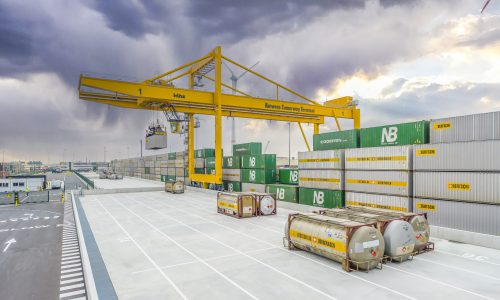
• Major investments: Antwerp Zomerweg Intermodal Terminal and extension of Rotterdam Botlek Intermodal Terminal, both including significant Dangerous Goods (DG) Isotank storage facilities. Middlesbrough land purchase to expand existing facilities.
• Outlook 2026: focus on reliability, customer value creation, resilient door-to-door logistics, and margin discipline.
Performance in a market defined by uncertainty
Bertschi Group entered 2026 with a clear message that customer value creation and targeted investments can still deliver growth, even when the market remains in stagnation. The Group closed the year 2025 with a turnover of CHF 1.02 billion, unchanged versus 2024 because of the strong Swiss Franc. Turnover in local currencies increased from the previous year by 2.5%, supported by growth in selected global markets and rising demand for storage and distribution solutions in Europe and Asia.
Tariff and regulatory uncertainties stayed on management’s radar throughout the year and repeatedly influenced customer decisions, procurement timing, and cross-border planning. In parallel, the European chemical industry’s downturn continued. Plant closures across the value chain reduced production activities in certain regions, while specific import streams increased and reshaped supply patterns. For Bertschi, the key task besides managing volume swings was to anticipate where the next trade redirections would appear and to respond with flexible capacity and execution.
“Volatility has become a permanent feature of our industry. Our job is to keep customers’ supply chains running reliably by managing the operational and compliance work in one integrated service backed by our infrastructure and expertise,” says Jan Arnet, Group CEO.
Proactively responding to shifts and new needs of global trade flows
As European chemical production stagnated overall, volumes from Asia, the Middle East, and the Americas gained weight in specific product market segments. Bertschi is positioning itself to support this reality through scalable hub infrastructure and end-to-end supply chain services. The Group’s strategy is built around being able to store, handle, heat, sample, clear customs, and distribute chemical products most especially in and around key import regions in Europe and Asia. “It is our responsibility to detect these shifts in global trade early and provide customers with secure logistics routes, even when the market reorganizes itself,” says Hans-Jörg Bertschi, Chairman of the Board. The objective for 2026 is to expand relationships with chemical producers, developing such new product flows.
Strengthening Europe as distribution region through continued investments
Investment remains a central lever in Bertschi’s long-term positioning. In Europe, the Group continued in 2025 to build capacity close to major ports and industrial clusters, with infrastructure that supports integrated logistics concepts.
The Antwerp Zomerweg Terminal (AZT) is a key part of the Group’s European investment agenda. Designed for modern, integrated chemical logistics, the terminal brings together container storage, particularly for DG, plus value-added services of customs solutions, heating, and trimodal connectivity. In Rotterdam, Bertschi completed an extension that strengthens throughput, handling, and DG storage capacities of the trimodal terminal and supports growing supply chain activities. The Group’s strong footprints in Antwerp and Rotterdam reinforce its position in Europe’s two leading chemical clusters, enabling customers to scale storage and distribution with predictable processes.
Bertschi also acquired land in Middlesbrough, creating room for further expansion of the UK storage and distribution hub in a market where logistical needs in the chemical segment continue to evolve. The UK market remains strategically important as global supply chains adapt to structural shifts in sourcing and production.
Global network expansion for customer proximity
With the establishment of operations in Mexico, Bertschi is placing a flag in a market that is increasingly relevant for chemical supply chains connecting North America, Central America, and global trade routes. “The aim is to provide customers with local expertise and a direct link to the Group’s global door-to-door service concepts,” explains Arnet.
New entities in Taiwan and Ningbo deepen the Group’s ability to support customers in Asia for regional distribution and for export-driven supply chains. These locations also help Bertschi follow the continued shift in production capacity and trade influence toward Asia. In Singapore, the Group expanded its Isotank heating capacity at its major global hub on the Jurong Island Chemical Cluster (JICC), reflecting sustained demand for integrated chemical logistics, where heating capability is essential, across Southeast Asia. In 2025, the chemical logistics hub in Zhangjiagang (Jiangsu Province, CN) successfully ramped up its business volume, supplying DG storage, drumming, warehousing, and distribution services to companies importing chemicals into the growing Chinese market, as well as for local producers.
Intermodal transport, and what “sustainability” will require in 2026
Sustainability goals remain present across the industry, but operational realities such as rail infrastructure disruption and reliability issues in Europe continue to put pressure on modal shift ambitions. For Bertschi, a priority for 2026 is to raise the consistency of planning and execution for customers and further reduce risks through resilient transport concepts. The Group supports industry initiatives aimed at improving intermodal performance through consolidation and higher-frequency services on key lanes. Sustainability progress in land transport will depend on operational reliability.
“Our customers want lower emissions, and they also want reliable arrival times. The next step is to make intermodal transport more predictable again. That’s where we’ll be putting a lot of energy in 2026,” says Arnet.
Bertschi overall anticipates a continuation in 2026 of a challenging market environment with overcapacities and cost pressure. Against this background, the Group will strengthen customer service with proactive communication and solution-oriented planning. Investments will remain selective and focused on infrastructure, equipment, and digital capabilities that improve reliability and scalability while maintaining the Group’s safety standards.
February 6, 2026
• Tariff and regulatory uncertainties weighed on demand for chemicals, while frontloading and friendshoring led to new, fast-changing patterns in chemical supply chains.
• Global network expanded with new subsidiaries in Mexico, Taiwan, and Ningbo.
• Singapore Isotank heating capacity expanded to support integrated supply chain services.
• European chemical industry downturn continued, with further plant closures announced and pressure on margins.
• Major investments: Antwerp Zomerweg Intermodal Terminal and extension of Rotterdam Botlek Intermodal Terminal, both including significant Dangerous Goods (DG) Isotank storage facilities. Middlesbrough land purchase to expand existing facilities.
• Outlook 2026: focus on reliability, customer value creation, resilient door-to-door logistics, and margin discipline.
Performance in a market defined by uncertainty
Bertschi Group entered 2026 with a clear message that customer value creation and targeted investments can still deliver growth, even when the market remains in stagnation. The Group closed the year 2025 with a turnover of CHF 1.02 billion, unchanged versus 2024 because of the strong Swiss Franc. Turnover in local currencies increased from the previous year by 2.5%, supported by growth in selected global markets and rising demand for storage and distribution solutions in Europe and Asia.
Tariff and regulatory uncertainties stayed on management’s radar throughout the year and repeatedly influenced customer decisions, procurement timing, and cross-border planning. In parallel, the European chemical industry’s downturn continued. Plant closures across the value chain reduced production activities in certain regions, while specific import streams increased and reshaped supply patterns. For Bertschi, the key task besides managing volume swings was to anticipate where the next trade redirections would appear and to respond with flexible capacity and execution.
“Volatility has become a permanent feature of our industry. Our job is to keep customers’ supply chains running reliably by managing the operational and compliance work in one integrated service backed by our infrastructure and expertise,” says Jan Arnet, Group CEO.
Proactively responding to shifts and new needs of global trade flows
As European chemical production stagnated overall, volumes from Asia, the Middle East, and the Americas gained weight in specific product market segments. Bertschi is positioning itself to support this reality through scalable hub infrastructure and end-to-end supply chain services. The Group’s strategy is built around being able to store, handle, heat, sample, clear customs, and distribute chemical products most especially in and around key import regions in Europe and Asia. “It is our responsibility to detect these shifts in global trade early and provide customers with secure logistics routes, even when the market reorganizes itself,” says Hans-Jörg Bertschi, Chairman of the Board. The objective for 2026 is to expand relationships with chemical producers, developing such new product flows.
Strengthening Europe as distribution region through continued investments
Investment remains a central lever in Bertschi’s long-term positioning. In Europe, the Group continued in 2025 to build capacity close to major ports and industrial clusters, with infrastructure that supports integrated logistics concepts.
The Antwerp Zomerweg Terminal (AZT) is a key part of the Group’s European investment agenda. Designed for modern, integrated chemical logistics, the terminal brings together container storage, particularly for DG, plus value-added services of customs solutions, heating, and trimodal connectivity. In Rotterdam, Bertschi completed an extension that strengthens throughput, handling, and DG storage capacities of the trimodal terminal and supports growing supply chain activities. The Group’s strong footprints in Antwerp and Rotterdam reinforce its position in Europe’s two leading chemical clusters, enabling customers to scale storage and distribution with predictable processes.
Bertschi also acquired land in Middlesbrough, creating room for further expansion of the UK storage and distribution hub in a market where logistical needs in the chemical segment continue to evolve. The UK market remains strategically important as global supply chains adapt to structural shifts in sourcing and production.
Global network expansion for customer proximity
With the establishment of operations in Mexico, Bertschi is placing a flag in a market that is increasingly relevant for chemical supply chains connecting North America, Central America, and global trade routes. “The aim is to provide customers with local expertise and a direct link to the Group’s global door-to-door service concepts,” explains Arnet.
New entities in Taiwan and Ningbo deepen the Group’s ability to support customers in Asia for regional distribution and for export-driven supply chains. These locations also help Bertschi follow the continued shift in production capacity and trade influence toward Asia. In Singapore, the Group expanded its Isotank heating capacity at its major global hub on the Jurong Island Chemical Cluster (JICC), reflecting sustained demand for integrated chemical logistics, where heating capability is essential, across Southeast Asia. In 2025, the chemical logistics hub in Zhangjiagang (Jiangsu Province, CN) successfully ramped up its business volume, supplying DG storage, drumming, warehousing, and distribution services to companies importing chemicals into the growing Chinese market, as well as for local producers.
Intermodal transport, and what “sustainability” will require in 2026
Sustainability goals remain present across the industry, but operational realities such as rail infrastructure disruption and reliability issues in Europe continue to put pressure on modal shift ambitions. For Bertschi, a priority for 2026 is to raise the consistency of planning and execution for customers and further reduce risks through resilient transport concepts. The Group supports industry initiatives aimed at improving intermodal performance through consolidation and higher-frequency services on key lanes. Sustainability progress in land transport will depend on operational reliability.
“Our customers want lower emissions, and they also want reliable arrival times. The next step is to make intermodal transport more predictable again. That’s where we’ll be putting a lot of energy in 2026,” says Arnet.
Bertschi overall anticipates a continuation in 2026 of a challenging market environment with overcapacities and cost pressure. Against this background, the Group will strengthen customer service with proactive communication and solution-oriented planning. Investments will remain selective and focused on infrastructure, equipment, and digital capabilities that improve reliability and scalability while maintaining the Group’s safety standards.
February 6, 2026
You currently do not have access to this article, please login or register to read more.
Login to read more

